
Originally published on X: View source thread

Intro
Arrakis just dropped an 80-page guide analyzing 125 token launches. Their framework: every TGE decision is a sell pressure decision. But what 80 pages accidentally proves, without ever saying it, is that the whole thing is an exhaustive manual for managing the rate at which you get sold into.
Not once do they say “here's how to make people actually want to hold.”
Every source of sell pressure is a form of user acquisition.
The guide
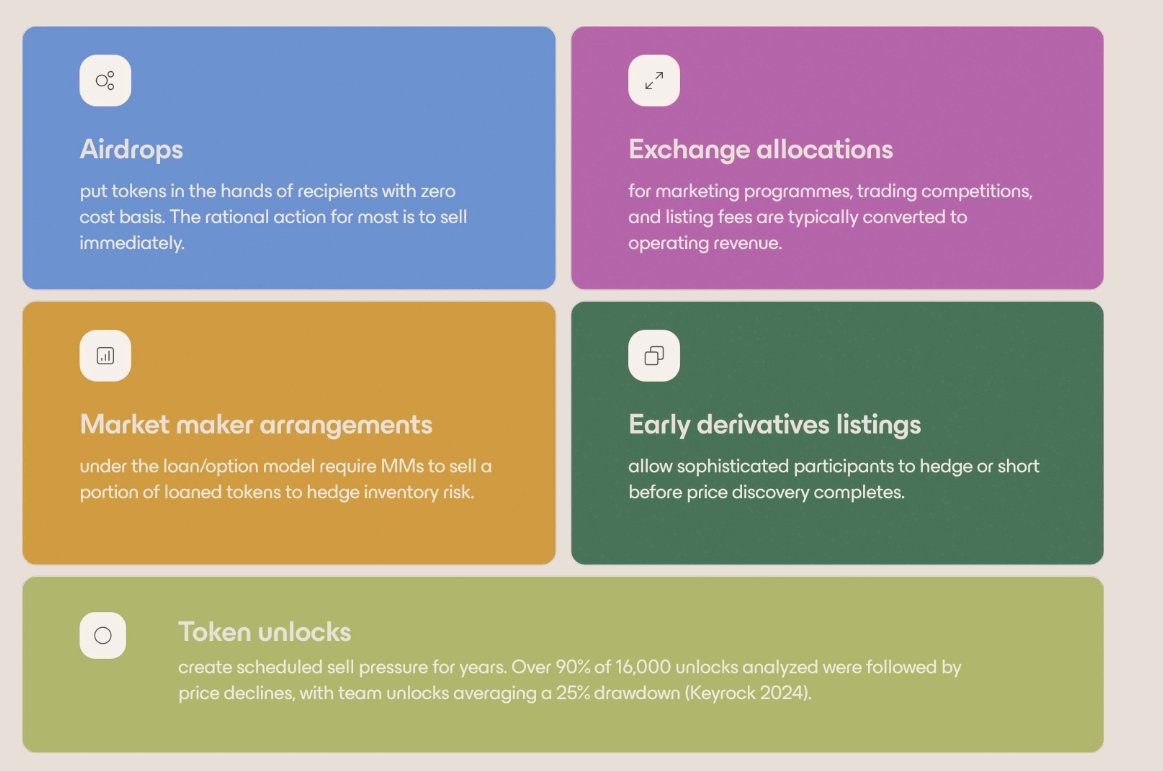
Read through the categories and notice what they have in common. Airdrops are user acquisition. Exchange allocations are distribution acquisition — you're paying in tokens for access to a venue's user base. MM loans? Liquidity acquisition. Even investment rounds eventually become sell pressure because they fund the liquidity that has to come from somewhere.
Every single one puts tokens into hands that are going to sell. The more distribution you buy, the more you get sold into.
The solutions reinforce the problem
So what do projects do about this? They hire market makers. Which makes it worse.
The loan/option structure that dominates the industry requires MMs to sell your tokens to function. A 3% supply loan means meaningful sell pressure before a single organic trade occurs. You hired someone to provide liquidity, and the first thing they do is dump your token to acquire quote assets.
DEX liquidity is the same thing wearing a different hat. A DEX market maker and a CEX market maker do the same thing: sell tokens to acquire quote assets. Whether it's an MM selling loaned tokens for USDT to place buy orders on Binance, or a protocol seeding a Uniswap single-sided position where the AMM mechanically sells tokens into stablecoins — same economic function. Tokens are being sold to create the appearance of a functioning market. And any fees or profits these market makers earn? Also denominated in the token. Also must be sold.
CEX market maker. DEX liquidity pool. Protocol-owned liquidity. Three names for the same thing: sell pressure with extra steps.
We've sat across the table from projects who spent 18 months building, only to watch 80% of their airdrop get dumped before lunch on launch day. That's not a failure of execution. That's a failure of structure.
Holding is irrational for anyone without a utility reason to hold
The guide proposes a useful litmus test: would there still be buy pressure if the market expected the price to remain flat indefinitely?
For most tokens at TGE, the answer is no. That tells you everything. If the only reason to hold is the expectation of price appreciation, every holder is waiting for someone else to buy at a higher price. When that expectation breaks — and post-TGE, it breaks fast — everyone is a seller.
No amount of vesting, lockups, or “diamond hands” culture changes this. You can delay selling. You can't make holding rational when the only payoff is speculative upside with unlimited downside.
Unless you change what people are holding.
Nobody has asked the obvious question: what if you just removed the unlimited downside?
Every token holder, airdrop recipient, VC, team member, and community member faces the same binary: hold an asset with unlimited downside, or sell it. The entire 80 pages is about managing the consequences of that choice. Smaller airdrops so fewer people face it. Lockups so they face it later. Better MM terms so the selling happens more slowly.
The binary is the problem. Not the sell pressure.
Traditional finance figured this out decades ago. You can buy equities with protective puts. You can hold structured notes with capital protection. Nobody in TradFi expects investors to hold concentrated, unhedged positions with unlimited downside and just hope. We built the most sophisticated financial infrastructure in history and forgot the one instrument that actually makes people hold.
This is what we built at Exchequer
Liquidity Preferred.
Liquidity Preferred is an onchain primitive we built that allows projects to give their holders full token upside while protecting their downside. Token drops, but the holder's loss is bounded. The collateral backing it is a structured product made up of an LP position that provides the floor and a reserve that funds the upside.
One move fixes the whole chain. Holders don't want to sell. Liquidity shows up without anyone dumping. And the treasury is actually doing something instead of sitting there waiting to be inflated away.
Apply this to every category
Airdrops: This is the big one. You don't need to give away tokens when you can offer something better. Downside protection is the incentive. Instead of distributing raw tokens that 80% of recipients dump on day one, you offer protected positions as the reward itself. Protection replaces emissions. The user gets something they actually want to hold, not a lottery ticket they need to cash before it loses value.
ICOs: Early buyers get raw tokens at a discount, then sit on unhedged positions praying the chart goes up long enough to exit. The ones who don't exit in time ride it to zero. Replace that with protected positions and you change the entire psychology of a token sale. Buyers aren't gambling on flipping before the music stops. They're buying a defined-risk position with a floor. The capital that comes in is stickier because the people holding it aren't terrified.
Unlocks: Unlocks exist for one reason: to spread the dump out over time so it doesn't kill you all at once. But you're still releasing it. Give holders protection that extends over time and they hold voluntarily. No countdown to a sell event.
Market makers: The locked LP collateral backing Liquidity Preferred is the liquidity. Protocol-owned, sitting in the AMM, generating fees, providing depth. No one needs to sell tokens to bootstrap quote assets. No loan/option structures. No forced hedging. The liquidity exists because the protection structure creates it as a byproduct.
Closing CTA
I could be wrong about the timing. Maybe the market isn't ready for structured products onchain yet. But the math doesn't care about timing, and 85% of tokens ending the year negative isn't a cyclical problem. It's a design problem.
Stop managing sell pressure. Just remove the reason it's there.
What's the biggest source of sell pressure you've dealt with post-TGE, and did anything structural actually work? Want to hear war stories.
DMs open for projects thinking about this pre-launch.