
Originally published on @SabretoothSG. Reproduced here with minor formatting edits.
We ran out of Exit liquidity.
Crypto feels broken right now.
The fashionable diagnosis is that crypto is “dead”. It posits that the industry has hit a wall because it remained insular, and the only path forward is for crypto to dissolve into the background of fintech, becoming invisible rails for “real world use-cases”.
I disagree. And I think I’ve found a way to fix it.
The idea that crypto is too insular pales in comparison to the actual problem: it is trying to cross the chasm with a product that is mathematically impossible to scale.
For the last decade, the primary product of our industry hasn’t been decentralization, or payments, or utility. It has been being early.
@cobie identified this pattern in 2022, noting that alt-L1s offered “being early as a service” to retail chasing the next Ethereum.
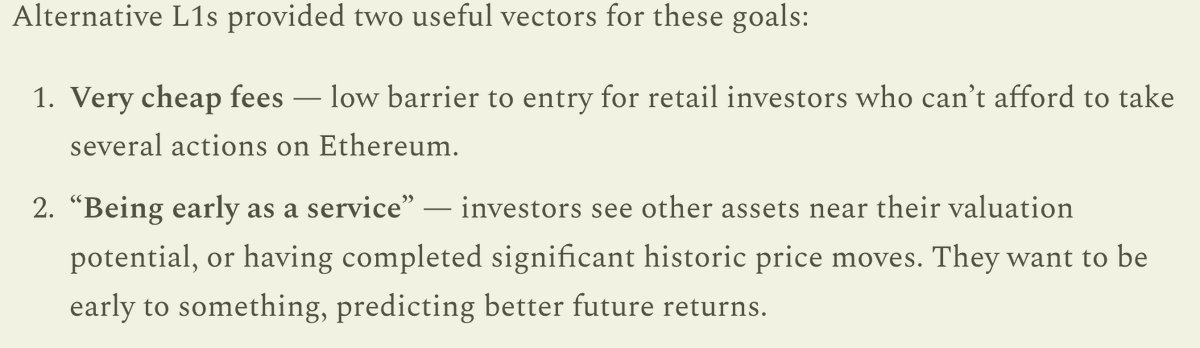
What he spotted as a retail behavior has since metastasized into the industry’s entire product line, and its fundamental ceiling.
Think about it. Every major crypto narrative is really just a different flavor of the same product. NFTs were going to revolutionize culture and creator ownership. Creator coins would let you invest in people. Memecoins promised community and fun. DeFi tokens offered governance and yield. But strip away the packaging and every pitch carries the same subtext: you are getting in before the others. What may appear as a utility token or some value accrual tied to equity, is really just a ticket to a timeline. A call option on future adoption.
This is why crypto feels like a collection of institutions whose sole job is to facilitate earliness as a product.
But @cobie was describing a symptom. The disease runs deeper: we industrialized being early across every vertical. Airdrops are retroactive paychecks for being there before the crowd. Market makers extract rent from the volatility of newness, and CEXes sell access to retail who think they’re early because they beat their neighbors. VCs sell earliness to LPs. KOLs sell earliness to their followers. Protocols sell earliness to liquidity providers. Even me writing this is a meta-play on spotting the end of the early game before you do. When the product is being early, the latecomers aren’t customers, they are the exit liquidity. We built an entire economy where the only true commodity is your timestamp.
The Paradox: The Token is the Bottleneck
Crypto worked brilliantly for Early Adopters. They are wired to buy risk. They are happy to buy a ticket to a timeline.
But here is the brutal truth about crossing the chasm that the industry refuses to admit: being early is a zero-sum product. By definition, it is scarce. For me to be early, you must be late. For me to realize a 100x gain, you must be the exit liquidity.
The bottleneck is that a token can only launch once.
You can only be early to a specific token once. Once the chart goes up and to the right, pmf dies for new entrants. This is why NFTs “died.” This is why creator coins “died.” This is why every memecoin eventually fades. The narratives didn’t fail. The product expired. People didn’t stop believing in digital art or social tokens or community coins, they just stopped being able to be early to them.
This is why we have a million tickers. This is why memecoin launchers are a thing. We have to keep printing new tokens to manufacture new day ones. We are trapped on a treadmill of issuance because the asset itself cannot sustain the narrative of earliness.
We are running out of people willing to be late.
Crypto keeps misdiagnosing this. When NFT volume collapsed, we said “people don’t care about digital art.” When creator coins flopped, we said “social tokens don’t work.” When memecoins fade, we say the “narrative is dead.” But the narrative was never the product. Being early was the product. And once you can’t be early anymore, the product is dead, no matter how compelling the story.
The Bitcoin Pivot: How to Reset the Clock
If you want to see how to cross this chasm, look at the only asset that has actually done it: Bitcoin.
In 2013, Bitcoin sold earliness to a new payment system (or magic internet money). If Bitcoin had stuck to that narrative, it would have died in the chasm. Why? Because by 2020, it was clearly too late to be early to a payment network that handled 7 transactions per second.
But Bitcoin didn’t die. It pivoted. It stopped selling earliness to payments and started selling earliness to sovereignty (aka digital gold). The clock was reset. Suddenly, buying at $30,000 could be viewed as being early to digital gold.
The MicroStrategy Hack: A Time Machine for Wall Street
But the narrative shift wasn’t enough. To truly cross the chasm to the late Majority (Wall Street, Pension Funds, Nation States), Bitcoin needed a new market structure.
Enter Michael Saylor.
Saylor understood something critical: The late majority & institutions want the upside of being early, but they cannot stomach the risk that comes with it. They cannot buy naked volatility.
So, MicroStrategy didn’t just buy Bitcoin. They built a time machine for Wall Street.
Through Convertible Senior Notes, MicroStrategy allowed institutional capital to bypass the earliness trap. The Deal: Institutions lend MSTR money at 0% interest. They get their principal back guaranteed. But if Bitcoin moons, they get to convert that debt into equity at a premium.
The Result: Hedge funds got to participate in Bitcoin’s earliness with the safety profile of a bond. This was financial engineering at its finest. It allowed latecomers to trade like early adopters. It transformed Bitcoin.
The New Trend: Unbundling the Token
The “Crypto is Dead” thesis suggests we should give up and become backend rails for Stripe. That is small vision. It’s also the wrong diagnosis. The narratives aren’t dead, they just need a new product. NFTs, creator coins, DeFi governance, none of these ideas were bad. They just had no way to survive their own success.
We’ve been early for long enough. It’s time to rewrite the definition of late. When a pension fund buys the Bitcoin ETF today, they don’t think they missed the boat; they trust the asset has matured. That is the feeling we need to engineer.
We are moving from the asset era where you simply buy the token to the structure era where you unbundle the token. A raw token bundles together massive upside volatility and catastrophic downside risk. The late majority cannot swallow that pill.
But we are seeing a new wave of protocols slice the token into different products for different appetites. So far, most of the innovation has focused on yield:
1. Stripping price from yield
Protocols like Ethena have proven that you can strip the price volatility out of crypto entirely. By taking the basis trade (long spot, short perp) and wrapping it into a stablecoin, they created a product for people who want the yield of crypto without the price exposure. They unbundled the funding rate from the asset.
2. Stripping variability from yield
Pendle actually predates Ethena by years, but took unbundling in a different direction. When you deposit a yield-bearing asset, Pendle splits it into two tokens: a Principal Token (PT) that’s redeemable for your original capital at maturity, and a Yield Token (YT) that captures all the future yield. Want guaranteed fixed returns? Buy PT at a discount and hold to maturity. Want to speculate on rates? Buy YT. They unbundled certainty from variability.
These protocols proved that unbundling works. But they both solve for yield, stripping out price exposure or locking in fixed returns. They’re products for people who don’t want the ride.
3. Protecting the user
The bigger breakthrough is unbundling the token for people who do want the ride, they just can’t stomach the risk of losing everything when buying tokens.
This structure already exists. It’s exactly what MicroStrategy offered hedge funds through their convertible notes: downside protected, upside exposed. That’s the product that let Wall Street finally touch Bitcoin.
But we can’t just copy-paste the Saylor model for alts. Let’s be honest about those convertible notes: the hedge funds got the risk-free upside, and MSTR holders paid the volatility premium (iykyk). We can’t build a new era on that kind of extraction. We need to invert the deal so the user gets the hedge fund protection, not the other way around.
We can invert this. Instead of users subsidizing institutions, the protocol subsidizes users.
This is what we’re building at Exchequer: a way for any project to offer downside-protected notes to their community. The project backs your position with its own treasury. You get partial principal protection, you keep the upside, and you earn yield while you wait. The protection isn’t coming from the next buyer. It’s coming from the project betting on itself, deploying treasury tokens as collateral instead of dumping them as mercenary incentives.
Airdrops pay people to leave. Liquidity mining attracts farmers who dump the moment they vest. But a downside-protected note attracts people who want to stay, they just needed someone to help with the other side of the risk.
The late majority doesn’t need a new narrative. They need a new product. One where they’re not exit liquidity, they’re protected creditors, holding the same asymmetric structure that hedge funds demanded before they’d touch Bitcoin.
Crossing the Chasm
Early adopters cross the chasm by jumping & taking risks. The majority will only cross it if we build them a bridge. That bridge is permissionless risk structuring.
For sixteen years, the only way to win was to be early. We built an entire economy on the subsidy of speculation. But that model has hit its limit. The next wave of adoption will not come from people looking for a lottery ticket, this is already clear.
We are entering a new era where the capital-protected structures that used to be the expensive domain of the ultra-rich are not only accessible to the masses, they are subsidized by the protocol.
Up to this point, we have subsidized risk by paying people to speculate. To cross the chasm, we must subsidize safety.
We don’t need to surrender the industry’s soul to become respectable. We just need to change who pays for the risk. We are building a market where the user’s safety is no longer a luxury they have to buy, but a standard feature paid for by the protocol. The era of being early is over. The era of being protected has begun.
And in that era, the narratives don’t have to die.