
Originally published on X: View source post

Crypto retail is not dumb.
They’ve looked into the abyss and realized that the "innovative ecosystem" they were promised is actually a cold-blooded, algorithmic meat grinder where they are the final product.
A "market structure" designed specifically to strip-mine their hope and convert it into exit liquidity for the elite. They know they’re stepping into a rigged arena where VCs buy in at fractions of a penny just to dump on their heads at a billion-dollar valuation the second a CEX flips the buy switch, while predatory market makers and founders suppress every green candle to hedge their own risk and KOLs lie to their faces for a free allocation they’ve already planned to sell.
There is no future, no community, and no long-term hold, only a frantic, soul-crushing race to the exit where the only way to survive is to betray the person next to you and jeet before the inevitable, programmed collapse.
They understand extraction.
The average retail user has been taught a simple lesson:
trust gets harvested.
Conviction gets used against you.
Loyalty often means being the one left holding the bag while someone else de-risks. So people adapt.
They sell earlier, dump the airdrop, jeet the launch, front-run the unlock. They stop acting like owners and start acting like cockroaches(survive at all costs).
That is not a character flaw.
The problem is that retail understands the current game all too well.
Image
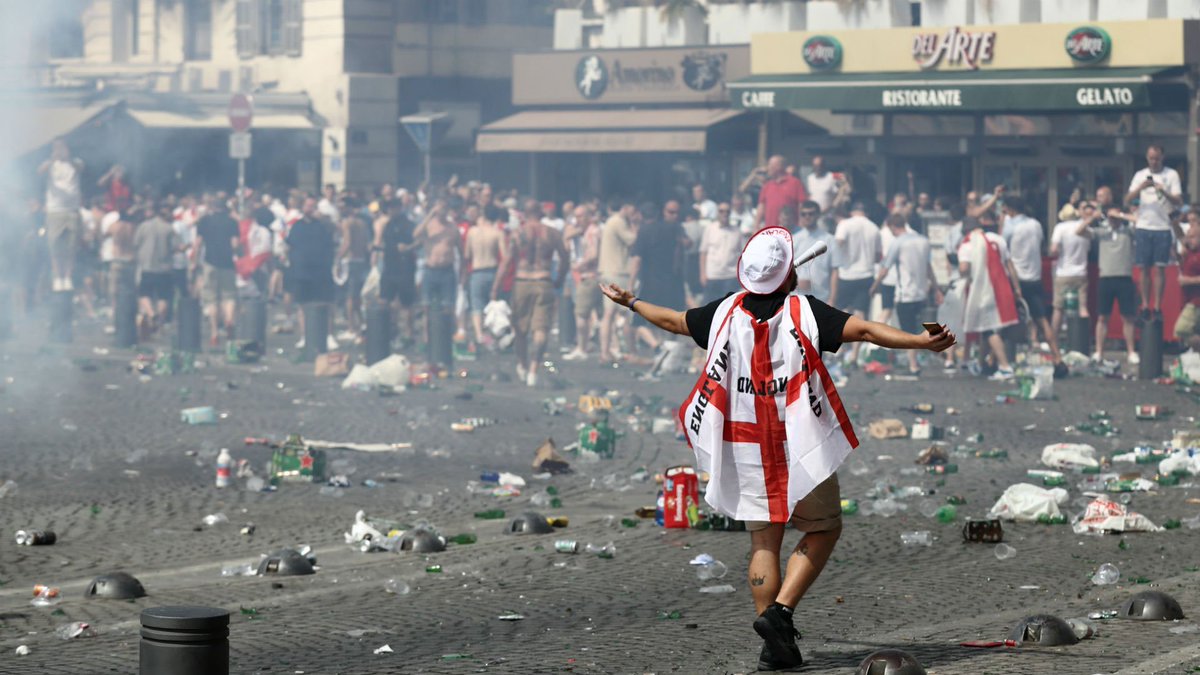
The closest analogy I know is the evolution of the "English football hooligan". For years, football supporters were herded like cattle through rusted, narrow turnstiles and shunted into steel cages during football matches. The very architecture of old stadiums told you that you were a beast, and you needed to be kept behind bars.
This created a self-fulfilling prophecy. When you treat people like animals for long enough, some start to bite. The frantic surge of the terraces, the adrenaline of a missiles launched from the shadows, and the tribal, jagged energy of treating the "away end" like a literal battlefield. It was a cycle of mutual loathing between the police and the fans, where every supporter was a suspect until proven otherwise.
Hillsborough where 97 people died showed the world the horrific end-point of seeing "the crowd" instead of the individual.
After Hillsborough, the cold steel of the cages was torn down, replaced by the simple, radical dignity of a seat with a name and a number. Police stopped treating supporters as a "hostile mass" to be contained and started treating supporters as people to be protected.
Disorder did not disappear completely, because humans remain gloriously capable of acting like idiots, but the old terrace-era pattern of mass, combustible confrontation is gone because the system stopped manufacturing it in the same way.
Crypto needs to do the same
So as a founder building in crypto, the real founder problem is not how to "market" your product better.
It is how to build products and market structures that leave the average user with a different sentence in their mouth.
Getting rich is the most powerful sentence in finance. Crypto has that one covered.
The problem is it's the only sentence. And it only works for some people, some of the time, in ways nobody can reliably repeat.
The sentence that builds something more durable — the one that compounds across cycles — is:
"I was treated fairly....
while I was trying to get rich..."
That is where trust begins.
First fairness. Then relief. Then maybe, if you sustain it long enough, trust.
What has to change
That is why I founded Exchequer, so all crypto protocols can issue a structure like Liquidity Preferred.
Not because they eliminate risk. They do not.
But Liquidity Preferred changes the emotional contract by backing founder promises with downside protection. By using project treasury reserves to back collateral that provides the user with a safety net that normal tokens lack. It tells users that trust is not automatically for suckers.
When a protocol implements downside protection, the conversation shifts. It’s no longer about surviving a 90% drawdown, it’s about asymmetric opportunity.
That is a much bigger deal than it sounds. Downside protection is a psychological bridge. It allows a participant to focus on the upside potential of the tech rather than the catastrophic fear of the floor falling out.
Until crypto can offer more people a memory of fairness, every new team inherits the emotional debt of the last cycle. Without these structures, we are asking the world to gamble on our integrity.
With them, we are proving it.